Showing posts with label NCAA. Show all posts

Wednesday, September 26, 2012

Penn State penalties

Today a report on CBS said, "Emmert pleased with Penn State's response to sanctions". My whole feeling on Penn State has been pretty clear but one thing I haven't spoke about is the penalties.

One particular comment from Emmert annoyed me,
"As a criminal investigation, it was none of our business," he said. "And if, back in 1998, Penn State had heard about it and put a stop to it, it would have never been any of our business. When they didn't do that, it became our concern."
I have a problem with that statement.

I don't think there's any question the administrators at Penn State covered up a pedophile but the one thing I just don't understand is how Emmert feels the university's responsibility goes back to 1998. The police were involved and dropped the case. A year later Sandusky left their employment. Some may conclude from that the university strong armed the local DA and forced Sandusky to retire but there is no proof. Yet the NCAA dates their crimes from that date.

A real crime was committed and it occurred in 2001. Key administrators knew about Sandusky's past and any slight suspicion should have set off alarms. Instead it was never reported and the guilty will be prosecuted.

As a fan of Ohio State, I am very aware of the passion Penn State fans have for their team. I am surrounded by fans with similar types of fans as is Alabama, Tennessee, Texas, Oklahoma and countless others. College football is based on the passion of fans and if you penalize one then shouldn't you enact legislation to penalize them all? Instead they make periodic examples to try to control the beast as the monster that has become college football pays the bills for NCAA athletics.

I do think Penn State should have gotten penalized but something more like vacating their wins since 2001 and a 5 year probation which would be the time they had to enact the proposals in the Freeh report. Instead they got penalties that will cripple the program and take it out on the current athletes that were in elementary school when the crime occurred.

The worst thing about this whole ruling is by doing it many think they are getting tough when in fact, college football is as out of control as ever. Money does that and until the college presidents accept that college football has grown to big and is now a professional enterprise, then then we will continue to see hypocrisies like penalizing Penn State back to 1998 to give the impression they are actually in control.

Friday, August 3, 2012

Leaving the NCAA. Is it possible?

Another of my cleaning out my drafts column.  Never completely finished but the point was that there are probably 40-50 teams that would make sense to join but conference affiliation makes it impossible.  Unless the college players form a union and force schools to separate football as a separate entity I don't see it happening.
-----------------

Any time a big time school is under investigation by the NCAA penalties decry the inequity of it all and suddenly you see statements by fans that say their team should leave the NCAA.  Some of this is just frustration that their team is about to be hit with penalties but it's also because the whole system is set up on the backs of 20 year old men so bad decisions on their part are to be expected.  The NFL doesn't have to worry about illegal payments, only that their players stay out of jail.

Most major college make tens of millions of dollars on the backs of their student athletes.  Texas, Alabama, Florida, and Ohio State all make between $50-80mm from their football programs will spending about $20-30mm to support them. The profit for each of these universities is used to support the other programs at the school.  The problem is that more and more people are coming after this money and while the total revenue for all schools continue to escalate that isn't going to continue forever.  With costs continuing to rise it is only a matter of time before the big schools do something to protect this income.

Could the big schools leave the NCAA?  

The first question is how they leave.  Many suggest that it should be made up of the conferences with automatic qualifition in the BCS while others feel a more selective process should be used.  I'm a big proponent of the second method but lets look at both:

BCS Conferences (B1G, Pac12, Big12, SEC, BE, ACC)
There are currently 66 schools in the BCS system with the SEC/B1G the strongest and the B12/BE the weakest.  68 schools is too many especially since so many schools have differing level of support.  Here's the attendance numbers for each conference for the 42 schools with more than 50,000 in attendance (with teams over 65,000 in red):

Big Ten (8/7)
1. Michigan 111,825
2. Ohio St. 105,278
3. Penn St. 104,234
11. Nebraska 85,664
16. Wisconsin 79,862
19. Michigan St. 73,556
21. Iowa 70,585
38. Illinois 54,188

SEC (11/9)
4. Alabama 101,821
6. Tennessee 99,781
7. Georgia 92,746
8. LSU 92,718
9. Florida 90,511
10. Auburn 86,087
18. South Carolina 76,668
22. Arkansas 68,932
25. Kentucky 66,070
35. Mississippi 55,898
37. Mississippi St. 54,999

Big 12 (6/3)
5. Texas 100,654
12. Oklahoma 84,738
13. Texas A&M 82,477
26. Missouri 61,540
32. Texas Tech 57,108
41. Oklahoma St. 50,812

Pac 12 (6/2)
15. Southern California 79,907
23. Washington 66,264
28. UCLA 60,376
29. Oregon 59,398
31. California 57,873
36. Arizona 55,408

ACC (6/3)
17. Clemson 77,469
20. Florida St. 71,270
24. Virginia Tech 66,233
30. North Carolina 58,250
33. North Carolina St. 56,877
39. Miami (FL) 52,575

Big East (3)
34. West Virginia 56,325
40. Pittsburgh 52,165
42. Louisville 50,648

Independant (2/1)
14. Notre Dame 80,795
27. BYU 61,381

As you can see  most conferences have a few dominant players with many others schools that don't have close to the same resources.  This system is a bit symbiotic as the top schools get wins and the bottom schools get money.  This has worked well in the past but the question is will it work if they break ties with the NCAA and the answer is mixed.  It can for the big conferences but not for the smaller conferences.  

That's why I think the answer is a combination of the B1G/SEC/B12/Pac12 along .  You could make an argument that the B12/Pac12 shouldn't be included but both serve a geographic area with huge college football traditions.  To these 4 conferences I'd add Notre Dame/BYU/Florida State/Miami/Virginia Tech.  

There are many obstacles in the way but the biggest is political and I think it is impossible to exclude the ACC if you include schools like Indiana and Vanderbilt.

Most Fans of College football want a 16 team playoff (which prove most fans are dumb)

Graham Watson at Yahoo Sports has done a series of blogs about the discussion BCS conferences and how they are most likely moving to a playoff involving 4 teams.  He asked the fans what they wanted and the overwhelming response was summarized by one response.
"A 4 team playoff would be really weak, barely better than what there is now," wrote Andrew from College Station. "8-12 is better, but it would still find ways to snub teams."
Overwhelmingly, those who responded seemed to be in favor of a 16-team playoff (an idea that I liked) that would include all 11 conference champions and five at large teams.
"I would propose a 16 team playoff with each conference champ included," wrote Chris from St. Louis. "The remaining 5 at-large bids would go (to) teams with (the) highest ranking. Would almost always have the top 8 - 10 teams included and give the little guy a shot. Makes winning a conference championship worth something."
I hate this idea because with 5 at large teams it makes the regular season meaningless.  I also hate it because there is no way the MAC, Sunbelt, WAC, Big East, Mountain West, or Conference USA should get an automatic bid.  More than that though it is naive and ignores some really big issues.

Logistics
Currently the college football season starts the last week of August and continues for 14 weeks (12 games and 1 bye plus one week for the conference championships).  To have a 16 team playoff you'd need a 4 week playoff.  Many that propose this system say you should put the conference championships the week after Thanksgiving.  Using this season as an example this would be the schedule:

Start of college football season: August 25th
End of college football season: November 17th
Conference championships: November 24th
1st Round: December 1st
2nd Round: December 8th
Semifinals: January 1st
Championship: January 8th

This would mean a few things.
  • The start of camp would be moved into July meaning players which is a time when many of them are taking classes which allows them to take a lighter load during football season.  
  • Fans expect the season to start in early September after Labor Day.  Moving it earlier could affect ticket sales/viewing (though I admit this is a weak argument)
  • College football's regular season would end on November 17th and bowl bound teams wouldn't have another game for well over a month.

None of these individually is a deal breaker but will be a concern for the presidents/commissioners that run college football.  This will be used as a smoke screen for the bigger issue in the next section.

Revenue Sharing
Most people believe that the only reason the BCS commissioners are meeting is because the BCS system isn't giving us a true champion.  That is important to the commissioners but it's about 10th on their list of importance.  Things above it are all about protecting the regular season, protecting the bowls, and protecting the BCS conferences share of the money.

I've touched on it in other articles but the main reason the commissioners are meeting is 1) the BCS contract is up in 2 years and they need to develop a new one, 2) they are tired of inroads the small conferences have made into college football, and 3) they are worried that the government is going to get involved and force them to do something they don't want to do.

The ratings in the last BCS bowls were terrible and that caused ESPN and the NCAA to panic.  That is why they are meeting but if you think we will ever have a 16 team playoff you are dreaming.

Friday, May 18, 2012

Breaking down the proposed NCAA changes

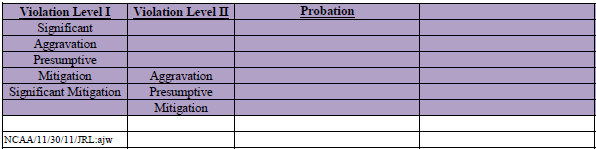
Many people aren't aware that the NCAA is in meetings that will make huge changes to the way it enforces its rules.  In January they released information an Enforcement Working Group was created after last August's presidential retreat and was tasked with "creating a tiered violation structure, new penalty procedures, a reformed process for adjudication and a reformed process that is fair while supporting the collegiate model the organization is looking to uphold."

This is matrix was the result.


  • Level I: Most egregious - A violation that seriously undermines or threatens the integrity of any of the NCAA enduring values (student-athlete success, the collegiate model, amateurism as a student model, competitive equity), including any violation that provides or is intended to provide a significant or extensive recruiting, competitive or other advantage, or significant or extensive impermissible benefit. Multiple Level II, III and/or IV violations may collectively be considered a Level I violation. Individual conduct that is unethical may be classified as a Level I violation, even if the underlying institutional violations are not considered Level I.
  • Level II: Serious - A violation that provides or is intended to provide a minimal to significant recruiting, competitive or other advantage; or includes a minimal to significant impermissible benefit; or involves a pattern of systemic violations in a particular area. Multiple Level III and/or Level IV violations may collectively be considered a Level II violation. Some limited individual conduct that is unethical or dishonest may be classified as a Level II violation, even if the underlying institutional violations are not considered Level II.
  • Level III: Those violations currently categorized as secondary violations - A violation that is isolated or limited in nature; provides no more than a minimal recruiting, competitive or other advantage; and does not include more than a minimal impermissible benefit. Multiple Level IV violations may collectively be considered a Level III violation.
  • Level IV: Minor or technical issues that do not rise to the level of a serious violation - An issue that is an action/inaction that is inadvertent and isolated; limited or technical in nature; and results in a negligible, if any, recruiting, competitive or other advantage of negligible, if any, impermissible benefit. Level IV issues will not impact eligibility.
Level 3 and Level 4 violations happen in all organizations and the lack of these is actually evidence of a control system that isn't robust.  For examples you can read this article where Ohio State reported to the NCAA all the secondary violations they incurred since last June.

Level 1 and 2 violations are what everyone is concerned about since that effects a team.  The reason for this change is in the past they really only had a few ill defined categories and they wanted a more defined penalty structure.  They haven't really classified the difference between the two but my guess is that a Level 1 violation is a Loss of Institutional Control/Failure to Monitor while Level 2 would include the lesser violations.  I'm sure this will solidify as they develop the system.

The question that this brings up is how would this effect cases like the ones that happened in the past like North Carolina, South Carolina, LSU, Ohio State, and USC. (I'm really simplifying the summaries - they are all much more complex than my statement)
  • North Carolina - Tutors taking tests and numerous coaches/players with illegal contact with an agent.  Failure to Monitor given - Level 1 Presumptive
    • NC would have gotten a 1% fine, a 1 year bowl ban, and scholarship reduction of between 11 and 21 players.  They got a 1 year bowl ban and a 9 scholarship reduction taken over 3 years.
  • South Carolina - Paying for players to stay at a hotel on campus - Level 2 Aggravation
    • South Carolina would have gotten a 0-.5% fine, no bowl ban, and scholarship reduction of between 0 and 11 players.  They received a $18,500 fine and a reduction of 6 scholarships over 2 seasons.
  • LSU - Illegal contact with player - Level 2 Presumptive
    • LSU would have gotten a fine of 0.-.25%, no bowl ban, and a scholarship reduction of between 0 and  5 players.  They got no bowl ban and a loss of 2 scholarships.
  • Ohio State - Players selling awards for cash, coach withholding information, booster giving improper benefits. Failure to Monitor - Level 1 Presumptive
    • OSU would have gotten a 1% fine ($300,000), a 1 year bowl ban, and scholarship reduction of between 11 and 21 players.  They got a 1 year bowl ban and a 9 scholarship reduction taken over 3 years.
  • USC - Loss of Institutional Control in regards to Reggie Bush and Reggie Mayo. - Level 1 Aggravation
    • USC would have gotten hit with a fine of 1-2% of program revenue, a 1-2 year bowl ban, and a reduction of between 21 and 32 scholarships.  They got hit with a 2 year bowl ban and lost 30 scholarships.
  • Miami FL - Shapiro = Total loss of control? - Level 1 Significant?
    • Miami FL will be interesting as I can't see how they could avoid the highest level.  That would give them a 1.5-2.5% fine, a 2-3+ year bowl ban, and a reduction of between 32 and 42 scholarships.
The biggest difference between these rules and the ones previously is it clearly defines what you can expect for the various levels.  It also gives the NCAA a way to better delineate between penalties as their current system has no metrics.1  These penalties have been increased though one point of clarification is whether the scholarship reductions are by year or in total.  I'm pretty confident it is in total as you'd need to kick kids out of college to meet a 42 scholarship reduction but some articles seem to feel it is annual.

The NCAA is meeting in May to finalize this but hopefully it will streamline the process and take a lot of the guesswork out of the penalty phase.

1 - I'm not fond of the significant, aggravation, presumptive, etc. titles.  Give the level a secondary letter grade and it will be easier to understand - For instance, Miami would have a 1A violation while LSU got a 2B. 

Monday, May 14, 2012

The current state of college football TV deals

The ACC just finalized their television deal with ESPN due to the additions of Syracuse and Pitt.  The Big 12 is in the final stages of their negotiations with ESPN/Fox as they lost aTm/Missouri and added of West Virginia/TCU.  The SEC is in initial talks regarding the addition of aTm/Missouri.  I thought it might be a good time to recap the television deals for college football.


The main motivation that got me to write this was was an article I read that stated that Florida State should leave the ACC and join the Big 12 due to their favorable deal.  The key in that article is that Florida State's athletic department is currently running a $2.4 million deficit and in the Big 12 Florida State would have the ability to create a Seminole Network.  The expectation is that this would bring in at least $5 million which would balance the budget.  I really can't believe Florida State would move for something as risky as that proposition but it has gotten traction over the weekend.  My guess is this is merely posturing to get concessions from the other ACC members at the meetings this week as the numbers don't add up.  There are rumors that ESPN and the Big 12 have agreed to a new deal that would give each team an estimated $20 million per season but I don't think it would be worth it for Florida State to leave for the $2.9 in additional television money when you consider the cost of additional travel.  I guess time will tell.

The other interesting thing about the spreadsheet is that most leagues seem to be happy they are getting Big Ten/SEC money and there is no doubt that ESPN stepped up to the plate and gave huge contracts to the Pac 10/ACC/Big 12.  Honestly when you think about television ratings I really don't think these deals can pay for themselves.  Are we really to believe that games in the ACC are worth $2.3 million?  I really think the key is ESPN is protecting its $5 per basic subscriber by making sure that they have long term college football contracts tied down all over the country so they have to be included on the basic tier.

That brings me to the SEC.  If the ACC is worth $2.3 million a game and the Big 12 is worth almost $2.7 million then what is the SEC worth?  That is where the question of subscriber fees vs ratings is interesting as the SEC's ratings are among the best though they are probably down the list when it comes to cable boxes in their area.  The SEC started their current deal in 2009 before prices really jumped and while their deal goes through 2016, I expect ESPN to cave and give them at least as much as the Big 12 for the addition of Texas A&M and Missouri.  If they don't the SEC could sell those home games to Fox/NBC/CBS for a huge sum and with 2016 not that far away they want to keep the SEC happy.  As you might recall, the Big Ten Network started because an ESPN executive dared Delany to find a better deal.  In the end I'd expect the SEC deal to be extended for at least another 10 years at least $3.0 million per game.

That brings us to the Big Ten.  Their deal is up in 2017 and they are biding their time as these deals have gotten increasingly ridiculous.  Looking at the Pac 12/Big 12, I expect the final deal to be a partnership between the ESPN and Fox for the 45 games   ESPN would prefer to have them all but they only really care that 1-2 games a week are on their station so it will be impossible for Midwest  cable companies to remove them from the basic tier.  That's because their main national competitor (DirectTV) will always have ESPN as basic and that combined with a section of the country that loves college football will make it hard to change.  This protects ESPN's $5/month which is the key.

So how much could the Big Ten get when they renew this contract?  Considering the games they are selling are the 3-4 best matchups every week they will get more than the average as their tier 2 games are shown on BTN.  My best guess would be at least $4 million in today's dollars.  That may seem high but if the Pac 10 can get $2.8 for all it's games then $4.0 million/game for the best Big Ten games seems pretty reasonable.  That's a nice bump from the $2.2 million per game they currently get and add an additional $7 million to each school in the league.

If the SEC and Big Ten get numbers like I expect the revenue per team for the next 15 - 20 years in college football would be as follows: Big Ten 27.7, SEC 23.0, Big 12 20.0, Pac 12 20.1, and ACC 17.1.  The Pac 12 numbers could jump a little if they are able to get their web based Pac 12 Network going for their Tier 3 content (games that Fox/ESPN don't want to run).  The same is true for Texas and the Longhorn Network.

A wildcard in the mix is Notre Dame as they will soon be making less than every other school in the top 5 college football conferences.  Their contract is up in 2015 and there are rumors that NBC may walk away as they are losing money on the current deal.  That's another clue that the real money in these college football deals is in subscriber fees as NBC doesn't get those as they are a broadcast company.  If they walk away then Notre Dame will need to negotiate with ESPN/FOX or possibly CBS/NBC's cable counterparts.  The issue for the Irish is one school isn't enough to motivate people to subscribe to a cable network so they will be negotiating from a position of weakness.  That leaves them with two choices - get the best deal they can from the cable companies to be included with the rest or work with one of them to form the Irish network.  There are undoubtedly thousands of Irish fans that would be happy to pay a premium for this channel.  That actually may be their best choice and one of the reasons for the recent talks with Texas and their Longhorn Network.

Unless they want to join a conference....

Monday, May 7, 2012

NCAA ordered to turn over all emails related to USC investigation

   
The McNair vs NCAA case has taken an interesting turn
How's it feel NCAA when the shoe is on the other foot? They fought hard but were just ordered by the court to turn over their internal emails in the Tod McNair case.


Frankly it surprises me that this hasn't happened more often. Why is it that the press has no problem filing a Freedom of Information request from an individual college but I've never heard of any of them doing it against the NCAA? Is it a private institution or are they just afraid of biting the hand that feeds them? My guess is they are a private organization which seems wrong to me since they rely so much on FoI in the press to persecute member organizations.

Speaking of that, I do find it a bit ironic that since USC is a private institution they are exempt from FoI requests and couldn't get the same scrutiny that hit Ohio State. This fact alone saved them from the circus that hit the Buckeyes.

Anyway, here's a C+P from the USC forums that details what is happening in the McNair vs NCAA case (If you've forgotten, McNair was the coach given the Show Cause penalty in the Reggie Bush ruling).

-------------------
Post on the USC Rivals Board:

TrojanJustice

So I checked out the public docket to see what's going on in this case and even paid a few bucks to get a key court order where the judge ruled on recent discovery motions. The big news is that McNair's lawyer filed a motion to obtain a commission to take Paul Dee's deposition in Florida. This is standard practice when you need to depose an uncooperative witness in another state. The court granted this commission on April 24, so very likely at some point this month the most corrupt administrator in the history of college football will be profusely sweating as he is grilled under oath about his breathtaking hypocrisy and abuse of power.

This development comes on the heels of the NCAA being ordered on 4/19/12 to produce all their internal emails about the Reggie Bush investigation. The NCAA vigorously opposed the production of the emails but lost. Not only that, after they failed to prevent the discovery of their emails, the NCAA tried to get a second bite at the apple by objecting to the courts' written ruling with an attempt to limit the production to only emails that specifically mention Tod McNair and were only between members of the infraction committee. So in other words, if there was, for instance, an email between a member of the staff -- not the committee -- and Lake asking Lake to doctor evidence, the NCAA would be able to withhold that evidence.

The court, in shooting down the NCAA yet again, seemed surprised by the NCAA's brazen request and stated in its ruling that "Restriction of the e-mails to only members of the Committee on Infractions is too limited as the contact by investigators and staff with the subject of Mr. McNair surely was not limited to the Committee."

Speaking as a lawyer, this is the kind of stunt you often see when the other side knows they are sitting on highly incriminating evidence and is trying to do all they can to prevent its disclosure short of criminal obstruction of justice.

No trial date set yet, probably about 6 months out based upon the state of the proceedings.
------------------

Here's the related court documents:

Request to depose Paul Dee (lead the NCAA investigation)

Order to turn over emails

Friday, March 30, 2012

How does Ohio State rate vs the historical basketball powers?

A little while ago I ranked the top football programs to see if I could identify the "football powerhouses".  It was a lot easier than I figured since stadium size and total wins seemed to have a good correlation and since 80% of the national champions come from this group, it is pretty hard to argue with the list.  This is much harder thing to do with basketball as one individual can change a programs fortunes for a few years only to see it fade into mediocrity once they leave.  A good example of this is Houston during the Akeem/Drexler years and San Francisco during the Bill Russell days.  This is made even tougher as coaches can have the same effect like what has happened at Indiana since Bobby Knight left or UCLA since John Wooden.

Powerhouses should transcend individuals but since there isn't a simple way to do it like in football I decided to instead see what programs have done the best over the last 60 years in the NCAA tournament::


Keep in mind this info is from before this year's tournament as I wanted to see how Ohio State ranked before this year's success. In addition, there is no doubt this graphic includes too many schools but I wanted to make sure I didn't miss anyone.  The methodology was pretty simple -- I took all the schools that made at least 3 NCAA Final Fours (plus a few I figured should be on the list) and then listed their number of Championships, Final Fours, Sweet 16s, and tournament appearances for the last 60 years.  Then I created a final column which is simply giving every school 1 pt for an appearance, 2 points for the Sweet 16, 3 points for a Final Four, and 4 points for a championships.  That means if a school won a championship they'd get 10 points that season (1+2+3+4).  It is no doubt arbitrary but it works for my purposes.

Powerhouses
As you can see from the list 5 schools separate themselves on the top - UCLA, Kentucky, North Carolina, Duke, and Kansas.  I don't think you'll get much argument from many that 4 of these are powers every season.  The issue is UCLA.  They've had their ups and downs but most of their rank is due to their success 40 years ago.  They really belong in a third tier group I'll discuss below as they've rarely been dominant in the last 20 years.

Lesser Powerhouses
The lesser powerhouse programs are schools that usually have success with a passionate fanbase but don't quite match the success of the first group.  I include Indiana, Louisville, Syracuse, Michigan State, and Connecticut in this group.  The only issue in this group is that before 2012 Indiana hadn't been to a  sweet 16 since 2002 though they seem to be back on track.  They were a no doubt powerhouse when Bobby Knight was coach.

The rest
I'm sure fans of schools like Arizona and Georgetown might disagree with being included in this grouping but they both benefited from having Hall of Fame coaches in Lute Olsen and John Thompson.  To be a powerhouse you have to do it over a long run and they haven't been able to climb back up to the top since those coaches left.

Ohio State compares favorably in this group especially when you consider there was a period from 1971 to 1992 that they didn't win a conference title.  Since then they've had their ups and downs and Thad Matta has definitely now has them in the conversation of sneaking into the lower group of basketball powers.  One this that could really go a long way to changing that perception is a national championship and Thad has a great opportunity to get one this season.  Even if it doesn't happen this year, if he can stay healthy then it is only a matter of time.

As a side note, I put all the football schools on the list above and highlighted them in RED. Someone noted a few years ago that the money going to the football BCS conferences was ruining college basketball as the smaller schools couldn't compete with the facilities. I'm not sure that is true because while the football powerhouses bring in the most revenue you can see from the chart that most of them struggle on the basketball court. It could be as someone joked that payments to football players leave little to give to the basketball players (just kidding!) but in all seriousness it is more likely that football powerhouses overshadow the basketball program.  Players and coaches have egos so it wouldn't surprise me if the best gravitate to schools that don't focus on football so they can be the BMOC (big man on campus). I don't know if that is true but it certainly makes Thad and the basketball Buckeyes success on the court all that more remarkable.

Monday, February 20, 2012

The Hierarchy of College Football

In one of my last articles I mentioned that the big time schools have symbiotic relationship with the  other universities.  Simply put, without the other schools to lose games, the big powers would have to play each other which would dramatically increase losses.  After writing that I thought it might be nice to identify the traditional powers and what makes them better than everyone else.  A cynic might jump to the conclusion that it's ultimately about money and certainly there is truth in that.  Before we jump to conclusions, I want to identify 4 classes of teams: Major, Minor, Doormats, and Cannon Fodder.

Major Powers

In my mind there are 15 teams that are major powers.  In my mind a traditional power is made up of 2 things - wins and fans that love to what their team win.  Here is the breakdown by Conference:

Big Ten
Michigan
Ohio State
Nebraska
Penn State

SEC
Alabama
Auburn
LSU
Florida
Tennessee
Georgia

Big 12
Texas
Oklahoma

ACC
Florida State

Pac 12
USC

Independents
Notre Dame


The list was a lot easier to compile than I thought.  I essentially used two lists: total wins and stadium size.  The 15 schools listed are the top 16 in terms of overall winning percentage (Miami-FL is 14th).  They also have 15 of the top 16 stadiums in terms of capacity (Texas A&M is 13th).  They've also won 42 of the last 50 NCAA championships with Miami the main culprit this isn't on the list with 5.

These facts alone demonstrate pretty clearly the have / have-not nature of college football.

Minor Powers


I am sure there are fans of teams not on the list that would feel slighted which is why I created another category of 17 which I call Minor Powers: Iowa, Michigan State, Wisconsin, South Carolina, Clemson, Georgia Tech, Miami-FL, UCLA, Washington, Oregon, Arizona State, West Virginia, Colorado, Virginia Tech, Boise State, Oklahoma State, Texas A&M, TCU, Missouri, and Arkansas.  These schools occasionally become relevant nationally but due to lack of resources and recruiting this only lasts a few season.  A few schools like Miami have threatened to be considered a "traditional power" but no other schools really fit the criteria.  Miami-FL is close as they've won 5 national championships over the last few decades.  I didn't include them because 1) they don't have their own stadium and 2) their fan base is ridiculously small and fickle.  They win due to the sheer talent available in South Florida as there isn't any close options nearby (Kentucky is almost as close to the Florida State campus as Miami).

Doormats

Schools not on either of the lists above but in one of the larger conferences - SEC, Big Ten, ACC, Big 12, Pac 12, and Big East would be considered a doormat.  That isn't to mean these schools don't have good teams or vie for major bowls from time to time but in the long term view of college football they exist in their leagues solely to provide wins for the traditional powers.

Cannon Fodder

Teams in schools from the Mountain West, Conference USA, MAC, Sun Belt, and WAC are the bottom rung in terms of national relevance.  They do provide an important service as they are the primary opponents in the "preseason" cannon fodder games.  These are nice tune ups to get teams ready for the conference schedule, provide both schools with a little bit of income, and make alumni happy as it greases the way to be bowl eligible.

That in a nutshell is the hierarchy in college football.  It has been this way for a long time and will continue far into the future.  The key is revenue.  Oregon and Oklahoma State have made a pretty good push in recent years mainly because of wealthy alumni that have put millions of their money into the schools.  That isn't sustainable long term as eventually their money will run out but if fans start to consistently fill their stadiums that will allow them to expand and further increase revenue.  When that happens, someone will be added to the list.  Until then you should expect the 15 school listed above to continue to win just about every year.

Friday, July 8, 2011

Best LoIC quotes from the NCAA's report on USC

Something the national media doesn't seem to understand is that a Lack of Institutional control penalty isn't about violations.  It's about whether compliance has necessary procedures in place to catch violations and whether a these procedures are strictly enforced as no one can ever stop isolated incidents.  The key is how you catch them and what you do when you find an irregularity.  I've summarized my favorite quotes from the NCAA report on USC and specifically the portion on lack of control on pages 46-55 of their report (NCAA Public Report on USC).  Then compare this list  to Ohio State who self reported and has mostly been in front of this the whole time from a compliance standpoint.  The two situations aren't even close.

USC had a 2 person compliance department -  "... adequate resources must be dedicated to compliance.  In this case, while the football violations were occurring, the institution had insufficient numbers of compliance staff to do the thorough and complete job..."

Adequate tracking processes for vehicles - "Adequate  processes also require that institutions obtain automobile registration records, and, when appropriate, records  documenting purchase and car payments, and not simply rely on uncorroborated information provided by student-athletes.  Neither of these processes was in place at the institution at the time."

Incomplete Automobile tracking - "... the FAR stated that the  institution would check to see if the information contained in the automobile registration form was complete, but it was "sometimes hard to get all of the information.""

Incomplete records specifically concerning Reggie Bush's car - "The institutional automobile registration form was incomplete; while it listed the date the young man had acquired the vehicle and from whom he had allegedly received it (his parents), the lines on the form for the license number and place of purchase were left blank.  The  institution did not require student athlete 1 to provide the missing information or the  records on the purchase and financing of the vehicle."


Carroll got Bush a job that provided the improper benefits with knowledge of compliance - "There was information in the record  that the former head  football  coach encouraged  sports marketer A to hire student-athletes as interns.  A current NFLPA certified agent ("sports agent B") is the chairman of a sports agency and a colleague of sports marketer A.  He reported that the former head football coach asked sports marketer A to consider hiring football student-athletes as interns in his agency."


Bush's employer seems nervous -  "Even though sports marketer A had assured the former director of compliance that he was doing everything  "by the book," the former director of compliance came away from the conversation with the impression that "the reporter shook up  (sports marketer A) and has him second guessing himself.""

An allegation by a reporter that Bush's employer seems especially close to him - "The e-mail from the former director of compliance concluded as follows: "I think we should call [student-athlete 1] in to discuss and confirm.  I can do that today (since they most likely leave tomorrow for the Cal game)."  However, no followup meeting with student-athlete 1 concerning the issues raised by the journalist ever took place.  The FAR claimed no recollection of receiving or reading the email."

Response to a Nationally published article - "... the institution failed to undertake even a limited inquiry into the issues raised by the journalist to determine if sports marketer A provided student-athlete 1 or his family with impermissible benefits.  The FAR could not recall anyone at the institution discussing the issues raised in the article, and the former director of compliance stated it was concluded within the department of athletics that the article was "sensationalistic" and "the internship was being misconstrued as something more than it was." "

Knowledge of improper payment of Bush's disability insurance policy - "... the former director of compliance received the forms from sports marketer B. The former director of compliance told sports marketer B that it was inappropriate for the sports marketing agency to be involved with student-athlete 1's disability insurance policy, but he did not take any action to sever the involvement or investigate the matter...  Instead, he passed the forms on to  an institutional athletics trainer, who assisted in completing the forms."

First approached by Mayo's "promoter" - ...  asked  his assistant coach to stay in contact with representative B regarding the recruitment of the two young men.  He did  so even after establishing that representative B was not a parent or guardian of the young men and called himself an "event promoter." To his credit, the former head men's basketball coach reported the meeting to the director of athletics and the compliance office."

Finding out the Mayo's "promoter" had been acted improperly in the past - "...within three weeks of
his initial meeting with representative B, he and his staff had learned  that representative B provided impermissible benefits  to the former student-athlete almost five years earlier.  When questioned about the situation, representative B denied he was a professional sports agent and told the assistant men's basketball coach  that the NCAA  had erroneously labeled him."

More allegations but no action taken regarding Mayo's recruitment - "... director of athletics went to the men's basketball office after receiving an e-mail from a sports reporter looking for a response to a report that representative B was a professional sports agent and involved with student-athlete 2.  When advised by the former head men's basketball coach that representative B had on numerous occasions denied he was an agent or runner, the director of athletics responded, "That's all I need to know," and left the office.  No further follow-up was done."

Director of Athletics and Director of Compliance's lack of understanding of NCAA rules - "... failed to recognize that representative B was a representative of the institution's athletics interests and that his involvement with student-athlete 2's recruitment was a violation of NCAA rules.  But even without making the booster connection, both of them were aware of representative B's provision of impermissible benefits to the former  men's basketball  student-athlete in 2001. This fact alone should have resulted in a higher level of scrutiny of representative B, but no further investigation was done."

Compliance eventually wants to end recruitment of Mayo but can't get support - "... director of compliance told the former head men's basketball coach of his concerns regarding potential problems in the recruitment of student-athlete 2.  The director of compliance recommended that the basketball coaching staff formally end  the  recruitment of student-athlete 2 given the very public questions about student-athlete 2's amateur status and the young man's association with representative B and his AAU coach.  The former head men's basketball coach failed to heed the advice, and the administration took no further action."

Wednesday, June 15, 2011

Should college football players get more money?

A discussion occurred on the topic of paying football players more money.  The comments that got me to respond were these:

  • We can't expect these guys to eat all their meals at the cafeteria and do nothing else but eat, sleep, study, and play football.
  • He isn't talking about survival, he is talking about a quality of life.
  • This is part of the reason why this country's economy is in such bad shape. Too many people trying to live beyond their means. It's not enough to have the basics, they have to have more. If someone wants something beyond that they need to budget and save, not ask someone else for more.

Here's my thoughts:
If college football used the free market they'd be paying millions in salary.  A free college degree isn't nothing

but it isn't close to market value at Ohio State.  Just to give you an example:  The NFL is the only free market football system we have in the United States and their contract requires that player salaries equate to a little over 50% of revenue.  When you consider that Ohio State football brought in over $70mm last year, if college football paid its athletes like the NFL, they'd have to pay $35 million to the players.  If you divide the $35 million by 85 scholarship players you get and average payout of over $400k which is over 10x more than they receive in scholarship benefits.

I'm not sure if you know this but there was a study done last year to calculate the cost of attending college that aren't covered by a scholarship.  It estimated the average at almost $3000 with Ohio State one of the highest with a  $4572 shortfall annually.

I don't have a problem with the current system because the situation is much more complicated than paying fair market as that would effectively end non-revenue sports in the country.  What I don't understand is why we can't pay the full costs of attendance that the NCAA itself acknowledges.  $4572 per player at Ohio State isn't a ton of money ($389k) when you look at the overall budget and it at least lessens the need for players to go elsewhere to look for alternative ways to get money.

The current system was fine 50 years ago but TV has changed everything.  It's well past time to try to make it a little fairer.

Friday, June 10, 2011

Call for the Death penalty for Ohio State

I see more and more people calling for the death penalty for the Ohio State football program.  I'd find it funny if it weren't such a serious situation.  Someone posted the question today if Ohio State should get the death penalty and this is my response:

Even as bad as it was, the NCAA later admitted they didn't realize the massive effect on SMU and wouldn't do it again.

If they did the same thing to Ohio State, they'd basically be shutting down 30+ other programs that were totally innocent.  The NCAA knows they are dancing with the devil when it comes to college football and the funding for all the other sports.  They can't kill the golden goose for fear of killing the whole thing.  Colleges are already hemorrhaging money from rising costs/government cutbacks so they depend on their football teams to pay for everything else.  Without football you don't have college athletics.

Players are paid comparatively very little when you consider their counterparts in the NFL.  Keeping kids away from people that want to buy access is impossible to achieve 100% of the time.  The colleges and the NCAA don't have near the amount resources available to police this so eventually every school is going to get hit.  All it takes is one kid that does something stupid and somehow it gets documented.  At that point the NCAA has to go through the motions and while the media points to the program and says, "Shame on you!" while behind closed doors their opponents all breath a sigh of relief, thankful that it isn't them.

((I'm in no way saying that I feel a lax compliance atmosphere or Jim Tressel's omission was acceptable.  I expect tough compliance at Ohio State and lying from the head coach is inexcusable.))

Wednesday, May 25, 2011

7n7 & Oversigning complaint that the current SEC proposal is too weak

His complaint is that the rule doesn't address the 85 and only moves the annual number from 28 to 25.

My response:

In some ways isn't a per year limit better than an 85 limit? I think the annual number should be lower than 25 though.

If the main worry of oversigning is that kids are being pushed out of programs unfairly then isn't the 85 limit part of the problem?

My thought would be to get rid of the 85 limit altogether and just set annual limits.  25 per year is too high so perhaps each school should only get around 23 per year which gives schools no incentive to push a player out the door unless they were a serious problem. Under that scenario if a coach kicked a player from a team, you'd know it was because of cause and not to make room to get under the 85 cap.

If you assume that a team uses all 25 signees in every class along with 50% redshirts that gives you 113 potential players without any attrition ((25 x 4) + (25 x 50%)). That means to stay at 85, schools in the SEC couldn't have an attrition any higher than 25% (1 - 85/113) or they'd run into Houston Nutt's current problem. I looked at most of the top 20 FCS teams last year and the average attrition was around 25% with the SEC higher so is the SEC proposal that bad?

In other words, if this rule passes most of the schools in the SEC couldn't afford to actively cut players since they will struggle to stay at 85 if they continue their past practice of recruiting borderline students and players with questionable character.  Mississippi can't even do that today.

Some quick math at different per year limits:

28: 34% (28x4)+(28x50%) = 128 -> 85/128
24: 22% (24x4)+(24x50%) = 108 -> 85/108
23: 19% (23x4)+(23x50%) = 104 -> 85/104
22: 15% (22x4)+(22x50%) =   99 -> 85/ 99

FWIW Ohio State is one of the best in the country at about 13% attrition (including players leaving early).  Most SEC school are over 25% with LSU/Mississippi leading the way closer to 35% and only Georgia unaffected though admittedly I didn't look at every school (I'd assume Vandy won't be affected by this either).

In a perfect world I'd prefer it if the NCAA changed their rule to an annual limit of 23 signee's with no roster cap as well as the ability to reward 2 players every August that have paid their own way for at least 2 years with a "walk-on" scholarship. Until then I don't think the SEC proposal is all that bad because it will make "cutting" players that much tougher and because it closes the 2/1-5/1 signing period loophole that many are exploiting.

No doubt I'd prefer they'd made the bill stronger and I'm sure the coaches in the SEC will find loopholes.  Ultimately the NCAA will need to come up with something more comprehensive so keep fighting the fight 7n7!